









We enable all participants in consent management to benefit from European lawmaking.
Join us create a fairer internet by fixing unfair and inffective data practices.
![[interface] image of employee interacting with hr software](https://cdn.prod.website-files.com/69b7b9ab93cf73e76cc11d89/69c3a6b09204d2bcb8233cac_4c51ae521bd312cb443c59b9034c1861_cb_process_00.webp)

Consenter Cookie Banner
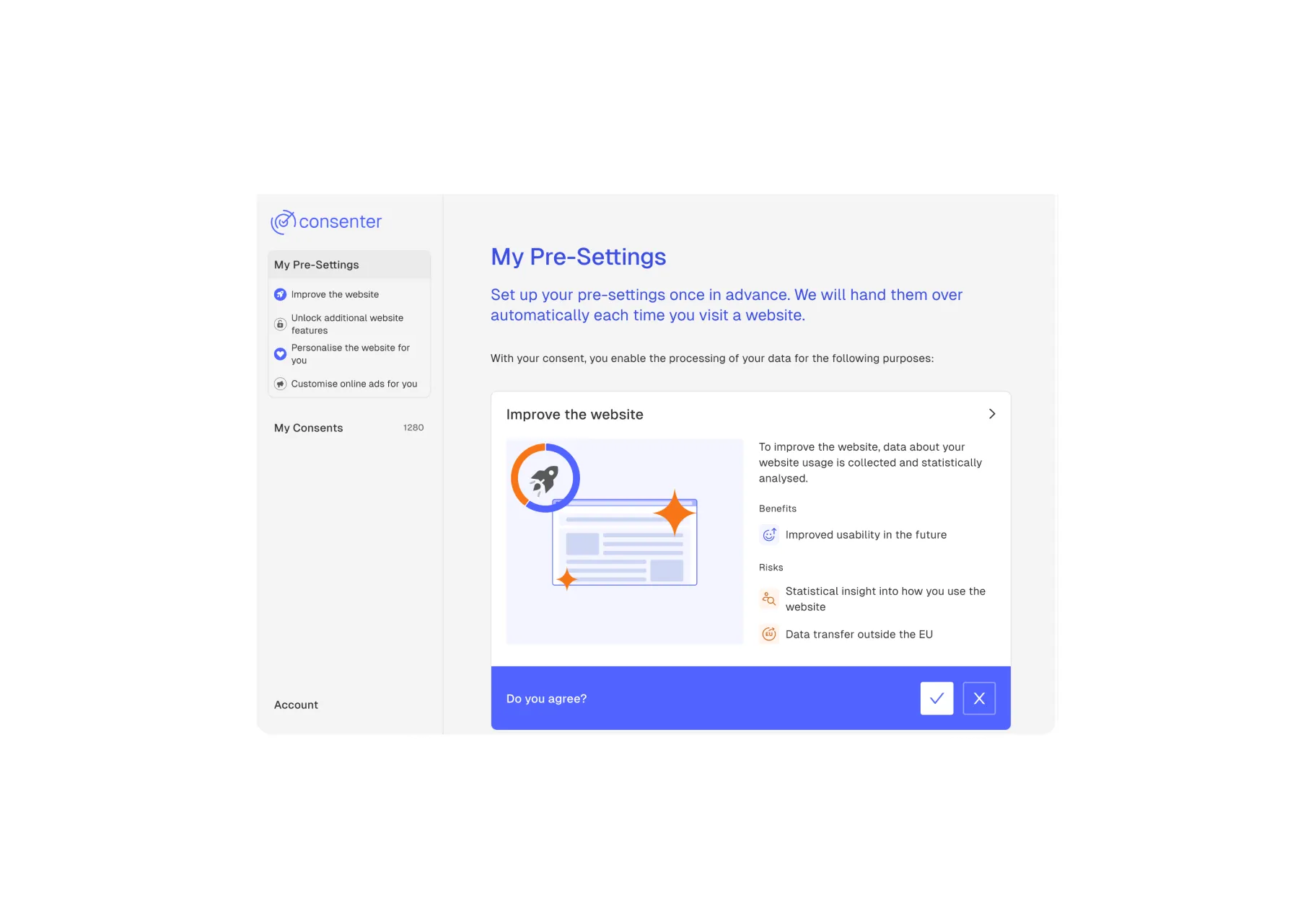
Consenter Consent Agent

Consenter Contextual Consent

Coming soon: Preference Center
Get the highest legal certainty for your website.
Increase your end users’ trust in data sharing.
More trust means higher consent rates.
Turn your compliance efforts into positive impact.
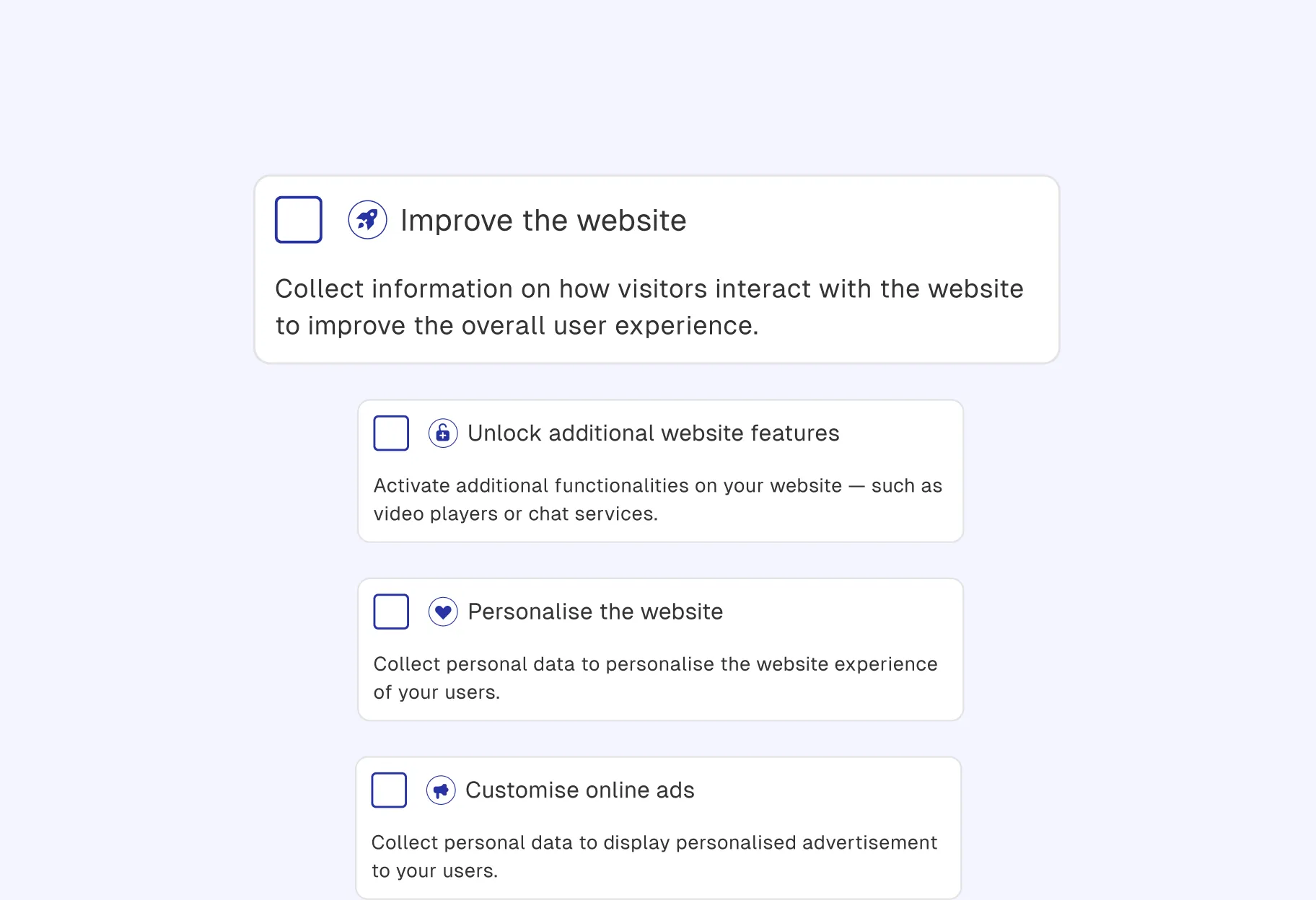
Choose the purposes for which you want to process the data from your end users.
Choose only the purposes you actually need.
This keeps your consent requests simple, avoids tiring your users, and helps you stay on the free or cheaper plan.
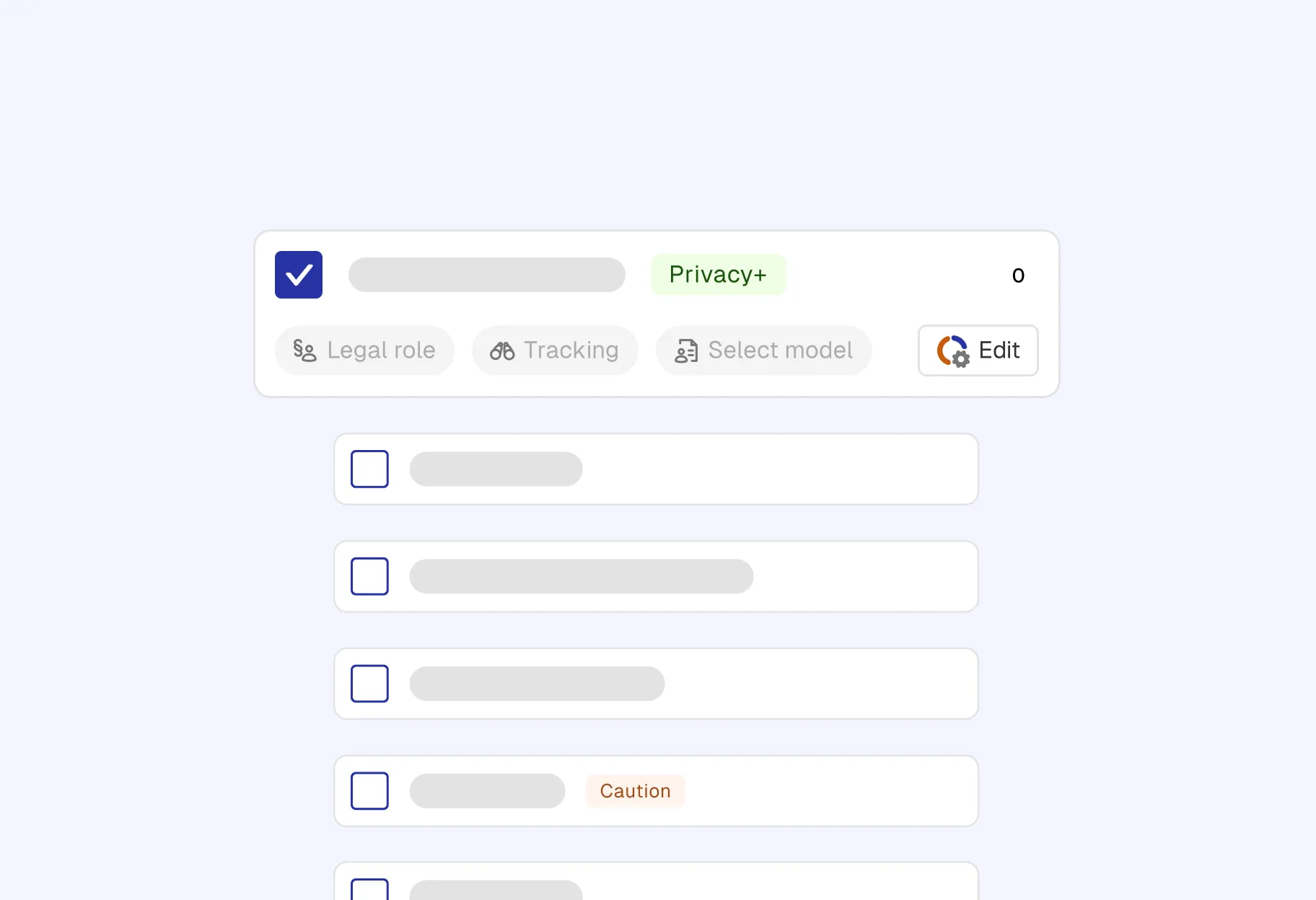
Most website operators simply use the most well-known tools in their default configuration. However, this often means they process more data and expose their users to more privacy risks than necessary.
We’ll show you which tools to configure and how, so you can strike the right balance between technical capabilities, privacy risks and your users' trust.
Ultimately, it comes down to striking a balance between maximising data usage and achieving the highest possible consent rate.
![[interface] image of hr software in action (for a hr tech)](https://cdn.prod.website-files.com/69b7b9ab93cf73e76cc11d89/69d750c0877b4852587a3281_cb_guidance_02.webp)
The technologies you have chosen may only collect your users’ data once they have given their consent.
To ensure that your tools do not collect data without your users’ consent, you must integrate them accordingly. We’ll show you how.
Here, we’ll also show you how to integrate contextual consent in relation to specific content or other triggers on your website.
![[interface] image of hr software in action (for a hr tech)](https://cdn.prod.website-files.com/69b7b9ab93cf73e76cc11d89/69d750c0fa2b05c903994a93_cb_guidance_03.webp)
Last but not least, you need to integrate the cookie banner – which you have completed in accordance with the steps above – into your website.
Now you have a state-of-the-art GDPR compliant cookie banner and can build trust with your users!
![[interface] image of hr software in action (for a hr tech)](https://cdn.prod.website-files.com/69b7b9ab93cf73e76cc11d89/69d750c0d690bcff87a6b898_cb_guidance_04.webp)
Don’t forget to update your cookie banner as soon as you change the purposes, technologies or their configurations.
The semi-automated Consenter risk assessment helps you keep your re-visiting users informed.
This allows you to build trust continuously!
Best if you wanna push the state of the art and/or have the skills
Do you have the legal, design and technical skills to build an informative cookie banner yourself? Or would you even like to further develop the state-of-the-art? Then you’ve come to the right place!
Best if you wanna get 100% trust and certainty with low efforts
Do you just want to be sure that you’re getting – with minimal effort – the maximum user trust and legal certainty? Then check out our pricing plans depending on the purposes for that you wanna process your users' data.
Empowering internet users to control the risks and get the benefits while browsing the web with seamless privacy-comfort.
Rewarding website providers with new state-of-the-art GDPR compliance that finally provides for a competitive advantage.
Making technology providers stand out in a trust-broken market with privacy as a product quality feature.